

Mental Health Resources and Tools
A collection of curated emergency and non-emergency mental health resources.
Emergency Resources
If you or someone you know is in crisis, in need of immediate intervention, and based in the US, please visit the Suicide & Crisis Lifeline or call/text 988. Information for other countries/areas can be found in the widget or Additional Crisis Lines section below.
Additional Crisis Lines
When experiencing an emotional/mental health crisis, it can be helpful to talk to someone trained to support people in your situation. Here are some popular American and international lines that offer free support for up to 24 hours a day. More international and state-based lines can be found at Suicide.org.
International
- International Association for Suicide Prevention – Lists crisis centers & lines in Africa, Asia, Europe, North America, Oceania, and South America.
- International Suicide Hotlines – OpenCounseling’s list of Emergency and Suicide Hotlines from all over the world.
United Kingdom
- Samaritans – 116 123 (UK) | 116 123 (ROI): UK-based helpline for mental health support, suicide prevention, and other issues.
Australia
- Lifeline Australia – 13 11 14: Australian crisis support and suicide prevention. Offers online support chat as well as phone chat.
United States/Canada
- National Suicide Prevention Lifeline – 1-800-273-8255: American crisis support and suicide prevention.
- Games and Online Harassment Hotline – The Games Hotline no longer provides the hotline but still has great resources.
- Stack Up – A military charity supporting veterans’ mental health through gaming. Stack Up’s trained suicide prevention volunteers, Overwatch, are online to help veterans and civilians 24/7 if you’re feeling overwhelmed and don’t know where to turn.
- Trans Lifeline – 877-565-8860 (US) | 877-330-6366 (CANADA): Crisis support line staffed by transgender volunteers offering support for transgender people. Available Monday – Friday 10AM – 6PM PT.
- The Trevor Project – 1-866-488-7386: American crisis support and suicide prevention for LGBT youth ages 13-24.
- Veterans Crisis Line – Call 1-800-273-8255, Text 838255: Support line for U.S veterans, staffed 24/7 by Department of Veterans Affairs responders. Online chat is also available.
- Crisis Text Line (Canada) – Text 686868: Canadian message-based crisis support and suicide prevention
- Warmlines (US) – A warmline is a peer-run listening line staffed by people in recovery themselves and listed by state.
Non-Emergency Resources
Mental Health Advocacy Websites
- American Foundation for Suicide Prevention
- American Psychological Association
- Autistic Self Advocacy Network
- Children and Adults with Attention-Deficit/Hyperactivity Disorder
- Depression and Bipolar Support Alliance
- International OCD Foundation
- Mental Health America
- National Alliance on Mental Illness
- National Association of Social Workers
- Schizophrenia and Psychosis Action Alliance
- Sensory Therapies and Research (STAR) Institute
Therapist Directories
Considering looking for a therapist? We have an infographic and a US-based flowchart that may help you decide what you need. We also have a several country-specific articles on How to Find a Therapist: United States, United Kingdom, and Australia.
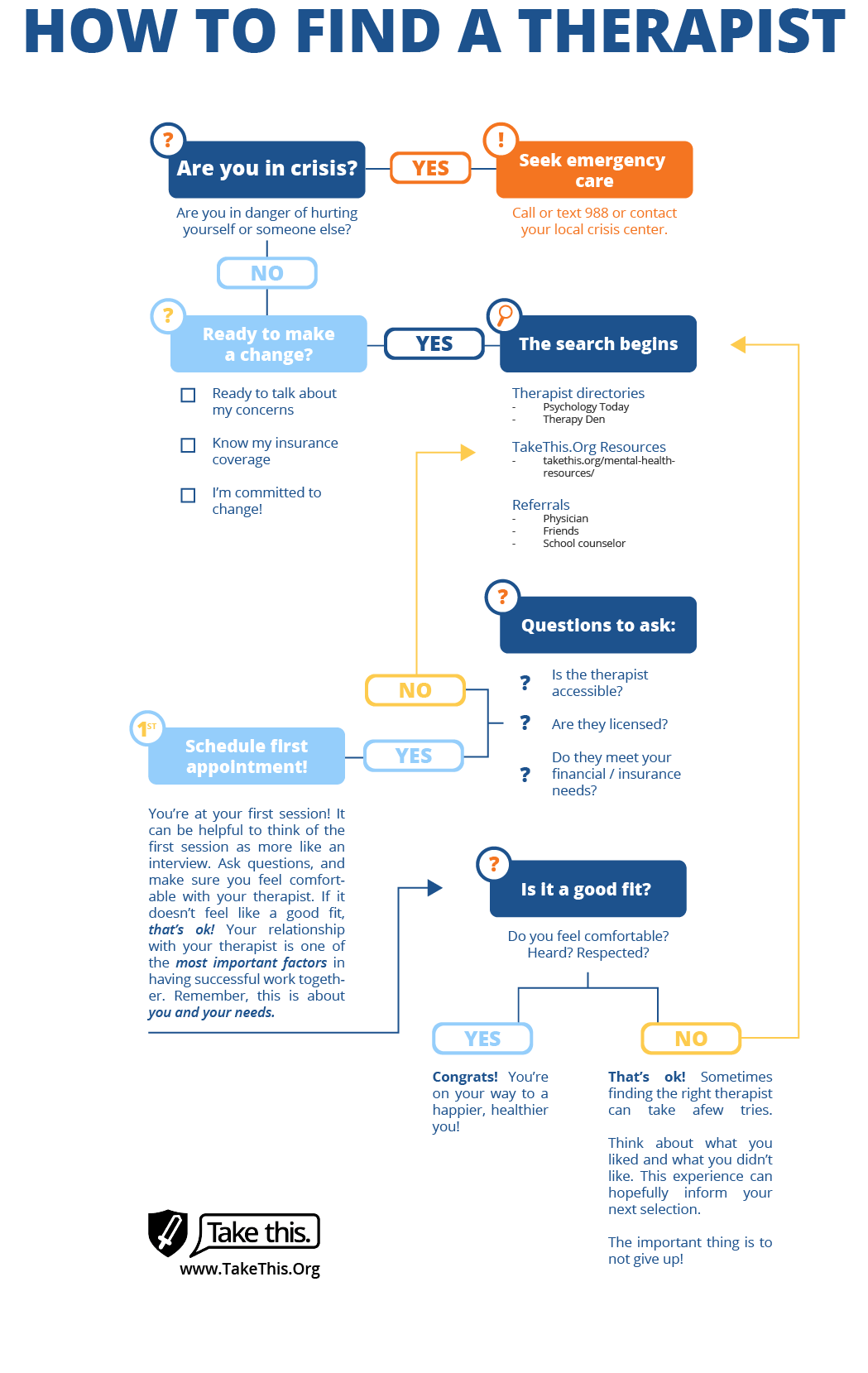
Below are searchable databases that list oodles of mental health professionals, and they can make finding a therapist much easier. They typically allow you to filter your search by a number of preferences, such as zip code, type of therapy, specialties, and insurance provider. Some even let you filter out things like the providers who are not taking new patients or those who provide services on a sliding scale. Once you’ve located some therapists in your area, our guide can help you find a good match.
- Asian Mental Health Collective
- BeingSeen
- Choosing Therapy
- GoodTherapy
- Gottman (Couples Therapy)
- Grow Therapy
- Inclusive Therapists
- International Therapist Directory
- JourneyStartsHere
- Latinx Therapy
- National Queer and Trans Therapists of Color Network
- Open Path
- OpenCounseling
- Psychology Today
- South Asian Therapists.org
- TherapyTribe
- Theravive
- Thriveworks
Tips for Finding a Therapist (International)
Finding a therapist that’s right for you is an important process that varies from country to country. With the help of our international colleagues, we’ve put together some guidance on finding a therapist in different nations around the world.
If you are looking for information on finding a therapist in the United States, check out this article instead.
Information courtesy of Hajar Zaiz
Hajar’s Recommendations
In Morocco, finding a therapist is often a combination of online search and recommendations from people you trust. Platforms such as Med.ma and DabaDoc can help you find psychologists by location and specialty, while Google reviews can provide additional information about other patients’ experiences. Word-of-mouth recommendations from trusted friends, family members, or healthcare professionals can also be particularly useful when looking for someone who understands your cultural background. Cultural fit and trust can be important considerations. Mental health remains stigmatized in parts of Moroccan society, particularly among older generations, and some people may still view psychological difficulties primarily through a religious or personal lens rather than as a healthcare issue. This can make privacy and finding a therapist you feel comfortable with especially important. Workplace attitudes can also make people cautious about disclosing that they are in therapy, so check whether your employer offers confidential mental health benefits or an Employee Assistance Program (EAP).
When choosing a therapist, consider their qualifications, areas of specialization, language, location or availability for online sessions, and whether you feel comfortable discussing your concerns with them. It is completely reasonable to speak with more than one therapist before deciding who is the right fit.
Useful Links
Information courtesy of Dr. JC Lau
JC’s Recommendations
- Start with your GP and a regular appointment. If you’re a resident in Amsterdam you will need to be registered with a local GP office. GPs are trained in general mental health issues and will ask you how you are (mentally) during your appointments, even for physical ailments. Most GP offices also have a mental health specialist that you can go to on your regular insurance, and they can cover short-term support and counselling.
- If you need additional support, you can ask your GP for a referral for Basis GGZ (regular therapy) or Gespecializeerde GGZ (specialized care/treatment usually if you have a specific condition such as ADHD, Autism, Anxiety, Bipolar disorder, etc.). These often have a waiting list which can be quite long. If you need something more quickly, you can ask for a virtual therapist appointment, or there’s also private services which you would pay for out of pocket.
- If you require emergency mental health services, call your GP and they can refer you to a specialist over the phone.
Useful Links
These links are primarily for expats/English-speaking therapists.
- https://www.iamexpat.nl/expat-info/dutch-news/essential-guide-mental-healthcare-netherlands
- https://www.therapycounselling.nl/
- https://www.iamexpat.nl/lifestyle/wellbeing/psychologists-therapists-counsellors-netherlands/family-therapy/english-speaking
- https://internationaltherapistdirectory.com/location/netherlands-1/
Information courtesy of Natasha Arthur
Natasha’s Recommendations
- Start with your GP (fastlege). Your GP can point you to services in your municipality, or refer you to a psychologist or specialist. Everyone registered as living in Norway has a right to a GP. You can find yours by logging in to Helsenorge.
- Check what your municipality offers by checking their website or asking your GP. Many municipalities have free “lavterskel” (low-threshold) services you can often contact directly without a referral:
- Rask psykisk helsehjelp (Fast mental healthcare): free short-term help for anxiety, mild to moderate depression and sleep problems, for ages 16+. It aims to see you within 1–2 weeks.
- Municipal psychologists: free short-term treatment for mild to moderate problems.
- Frisklivssentral (Healthy Life Centre), courses on depression or stress, and outreach teams if you can’t attend appointments.
- Specialist care (DPS) is a public health service available for more serious or long-lasting problems. Your GP can refer you to a district psychiatric centre (DPS) or hospital. Wait times vary a lot depending on where you live. Some hospitals also offer online treatment (eBehandling).
- There are also psychologists with a public agreement (driftsavtale / avtalespesialist). These are private psychologists who have an agreement with the regional health trust and are part of the public health service. You pay a fixed fee per session (egenandel) that counts towards your frikort (exemption card). If you are under 26, you pay no user fee. Wait lists are often long, so it’s worth contacting several.
- Fully private psychologists are also an option. You pay the full cost yourself, but can often get an appointment much faster. Make sure to check that the person is an authorised psychologist. “Psychotherapist” is not a protected title in Norway.
- Helsenorge also offers digital self-help. You can find a directory of free, professionally approved tools for stress, anxiety, low mood and sleep problems.
Useful Links
- Mental healthcare for adults in Norway (English): https://www.helsenorge.no/en/psykisk-helse/mental-healthcare-for-adults-in-norway/
- Same page in Norwegian: https://www.helsenorge.no/psykisk-helse/psykisk-helsehjelp-for-voksne/
- How to get a psychologist, including waiting times and costs (English): https://www.helsenorge.no/en/psykisk-helse/psychologist-in-norway/
- Find psychologists with a public agreement (driftsavtale): https://www.legelisten.no/psykologer?service_type=pub
- Find a private psychologist (Norwegian Psychological Association): https://finnenpsykolog.no/
- Mental Helse, a phone and chat service if you need someone to talk to: https://mentalhelse.no/
- List of approved digital self-help tools: https://tjenester.helsenorge.no/verktoy
Information courtesy of Dr. Christopher Leech
Christopher’s Recommendations
(A more detailed article by Dr. Leech on finding a therapist in the UK can be found here.)
The UK has a few different routes you can take to access therapy. The most important thing to understand first, though, is “who” can deliver therapy. “Therapist” and even “Psychologist” aren’t outright protected titles in the UK so anyone can use them or other types of “coaching” words to deliver therapy. You’ll typically be looking for one of the following:
- Psychiatrist – has a medical degree and specialised in the brain/psychology. They can provide prescriptions. Often, psychiatrists work in hospitals or facilities rather than provide publicly available therapy.
- Psychologist – Psychologists do a lot of different work. Research, teaching, and can include expert or therapeutic work. Psychologists typically complete a doctorate in psychology, usually a research-focused PhD. However, some psychologists qualify as “psychotherapists” if they complete additional, clinically focused, supervised training and register with a psychotherapy council.
- Counsellor – Counsellors are arguably the most accessible type of therapist in the UK. They may have one or more degrees in counselling, counselling and psychology, or may have completed a counselling-specific course. They typically engage in talking therapies, most commonly Cognitive Behavioural Therapy (CBT). Registration with various councils is optional in the UK, but registered professionals are recommended.
In terms of access you generally have the following options:
- Through the NHS/your General Practitioner (GP) or self-referral (Click here)
- Through your workplace or School/College/University
- Through a national/local charity
- Privately
Useful Links
- Professional Standard Authority – This is a service-specific search for registered professionals.
- UK Council of Psychotherapy (UKCP),
- British Association for Counselling and Psychotherapy (BACP)
- British Psychological Society (BPS)
We’ll be adding more countries to the list as we get more information, so if you don’t see yours, check back soon.
If you are a mental health professional in a country that isn’t listed yet and would like to help us get your country added, you can reach out to us at in**@******is.org.
Online Therapy Resources
Online therapy is an alternative to face-to-face therapy that’s often chosen because it can be less expensive, more accessible or less intimidating. Before choosing online therapy over in-person therapy, read the American Psychological Association’s recommendations. Below are some popular online therapy services that may be available in your area.
- 7 Cups of Tea: Free online text chat with trained non-clinician listeners and paid online therapy with licensed therapists.
- Doctor On Demand: Paid video chat with psychologists, psychiatrists and primary care physicians
- TherapyDen: A mental health directory and resource making finding the right therapist or counselor as painless as possible.
But Is Therapy for Everyone? Glad You Asked host Fabiola Cineas explores why we don’t prioritize our mental health and how you can seek out the mental health care that’s right for you.
Culturally-Specific Therapeutic Support (US)
- Asian American Psychological Association: Community of Asian American psychologists and other mental health professionals who advocate on behalf of Asian Americans as well as advancing Asian American psychology.
- Asian Mental Health Collective: Non-profit that aspires to make mental health easily available. approachable, and accessible to Asian communities worldwide.
- Friendship Bench: Provides sustainable community based psychological interventions that are evidence based, accessible and scalable.
- Latinx Therapy: Bilingual therapist directory and podcast working towards destigmatizing mental well-being in the Latinx community.
- Loveland Foundation: Therapist directories, offers mental health fund for Black women and femmes.
- National Queer and Trans Therapists of Color Network: Works to increase direct access to queer and transgender mental health practitioners, provide resources rooted in social justice and liberation, as well as technical assistance for social justice organizations.
- South Asian Mental Health Initiative & Network: Non-profit that addresses the mental health needs of the South Asian community in the U.S. with education, resources, and services.
- Therapy for Black Girls: An online space committed to encouraging the mental wellness of black women and girls. It features a directory of therapists as well as a weekly podcast highlighting all things mental health for black women.
Online Harassment Support
Online harassment is endemic in our gaming communities, and harassment can contribute to mental health issues. These resources seek to provide practical and emotional help for anyone who is being harassed.
- GamesHotline: The Games and Online Harassment Hotline is a free, text message-based, confidential emotional support hotline.
- IGDA’s Online Harassment Resource: A directory of tools and articles available to those dealing with online harassment.
- Online Harassment Field Manual: A comprehensive manual for those who are targeted, witnesses, or employers. It offers concrete strategies for how to defend yourself and others.
- Speak Up & Stay Safe: A checklist for securing online and offline information to help avoid doxxing, or having your home address shared online.
- Fear of False Accusations
- Responding to Disclosures
Streamer & Content Creator Resources
- Burnout 101 and Burnout for Content Creators: A multi-part, educational series on burnout created by Take This’ Dr. Kelli Dunlap and Dr. Raffael Boccamazzo and especially tailored for content creators.
- Managing Chat When People Bring Up Self-Harm: A new series of videos providing mental health education to content creators on a variety of topics, sponsored by Rainbow Six.
- How Streamers Can Respond When Viewers Need Help: Addressing mental health needs on Twitch and other streaming platforms has been a growing concern, especially given the lack of research that exists on the topic.
- Creating a Culture of Support in the Gaming Community: A collection of tips for streamers from Take This, the American Foundation for Suicide Prevention, and AdCouncil.
- Twitch Cares: Mental Health Support & Information Mental health resources for the Twitch community.
- YouTube Safety Center: Information on how to report self-harming or suicidal users to YouTube’s safety team.
- How to Stay Safe from a Hate Raid: This guide from GamesHotline was created as a way to bring together the vast community knowledge and tools that have surfaced in response to the increasing hate raids on Twitch.
Self-Care Tools
Daily self-care can be difficult, particularly when you’re dealing with mental health issues. These supplementary resources were created to make remembering important self-care steps easier.
- Everything is Awful and I’m Not Okay: A one-page, printable list of questions to ask yourself when you’re feeling bad.
- Self-Care Starter Kit: University at Buffalo’s guide to starting a self-care routine that prioritizes wellness.
- You Feel Like Sh*t: An Interactive Self-Care Guide: As described, a choose-your-path guide to taking care of yourself on days when that’s difficult.
Apps and Other Tools
There are thousands of mental health, self-care, and wellness apps available. Below are a few examples.
Note: Mental health apps and tools are not a substitute for qualified mental health care from licensed providers. Mental health apps and tools listed here are listed for informational purposes only. The use of any mental health apps or tools is at the sole discretion of the user. Take This makes no claims as to the efficacy or applicability of any of these apps or tools, nor does Take This endorse any of them. For information such as the user experience and data transparency of various mental health-oriented apps, please check out the nonprofit project One Mind PsyberGuide.
- 5 Minute Journal (iOS, Android): Daily journal for gratitude, positive reflections, and photos.
- Calm (Web, iOS, Android): Guided meditations accompanied by natural soundscapes.
- DBT Diary Card and Skills Coach (iOS): Coaching and ongoing support for users who are currently engaged in DBT with a therapist.
- Habitica (Web, iOS, Android): Gamified habit tracker and to-do list. Includes monthly self-care challenges from Take This.
- Headspace (iOS, Android): Paid guided meditation program.
- Mightier (Web): Paid clinically based games for kids with ADHD, ODD, or anxiety.
- MindShift (iOS, Android): Anxiety resources and coaching for teens and young adults.
- SleepCycle (iOS, Android): Sleep tracking and alarm clock.
- Start Your Recovery – Easily digestible, relatable information for people who are facing substance use issues — and for their support networks, too.
- SuperBetter (Web, iOS, Android): Gamified app designed to increase resilience and encourage good habits.
- Taming Gaming List of games that are helpful for mental health – includes games that have been helpful for specific mental health challenges, as well as games that help us understand the challenge faced by the people we love.
- What’s Up (iOS, Android): CBT and ACT-based tools for dealing with anxiety and depression.
Haven’t found what you’re looking for? See also:
Disclaimer
The above list of mental health resources is not a substitute for medical advice or professional counseling. While we at Take This want to provide you with resources, we do not recommend or endorse any particular site, treatment, therapy, or resource. We provide these links at our sole discretion but have not necessarily vetted or reviewed any particular resource. We assume no liability for the use of the information or resources on these sites and encourage you to use your own best judgment when reviewing these resources.
If you live in the US and you’re having suicidal thoughts, reach out to the Suicide & Crisis Lifeline by calling to texting 988. If you’re outside the US, you can find local crisis lines at Suicide.org. If you’re even debating whether you should call them, you should call them. The Suicide & Crisis Lifeline handles all psychological crises, not just suicide.